Benchmark · video-language models

RepProbe

Mahsa Khoshnoodi, Sarah Adel Bargal

Georgetown University · GUCV Lab

RepProbe is a 42K-clip benchmark of real and synthetic videos with exactly k ∈ [1, 20] complete repetitions, controlled for position, coverage, and duration. Counting accuracy collapses at high k across video-language models, yet a linear probe on the last-layer residual still recovers the count: the failure is at generation, not in what the model encodes.

Real
Synthetic

Construction

Exact k from rest-pose bounds

Real clips are cut from official RepCount rest-pose timestamps. Consecutive L-marks define one cycle; a k-clip is a contiguous window of k cycles closed on those rest poses. The label is the number of intervals in the cut, so it cannot drift from the source annotation.

Source & bounds

RepCount videos with L1, L2, … rest-pose frames from the official CSVs.

Cycle intervals

Pair consecutive L marks into half-open [start, end). One interval is one repetition.

k-windows

First k, centered k, and last k cycles when the source is long enough.

Prompt

The cut clip and “return only an integer” are the two inputs to a video-language model.

Because k comes from the annotation, it needs no human or model recount, and a k-clip cannot bleed into the next motion.

Real split

Windows on one source

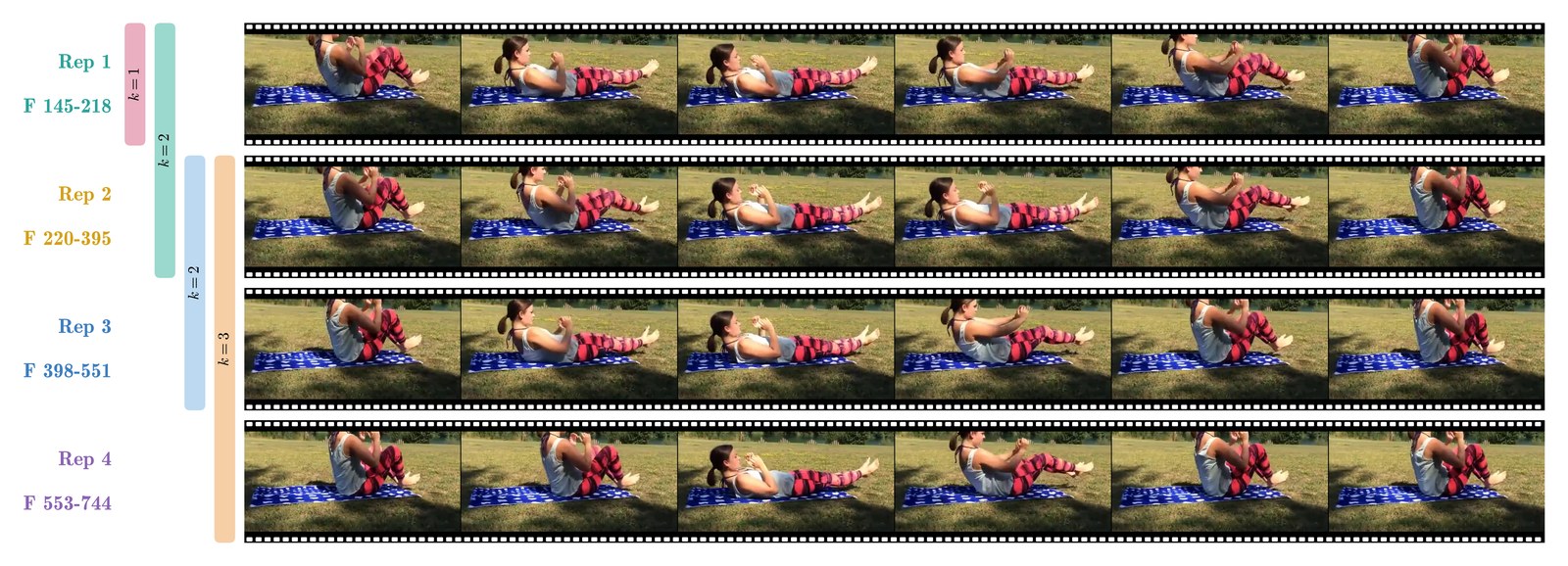
Four sit-up cycles from one RepCount video. Adjacent cycles share a rest pose. The k-clip for each k is the first k of those intervals; the cut never falls inside a repetition.

Four sit-up cycles from one source, tiled by repetition, with k=1 through k=4 windows marked along the left.
Clip (left) and corresponding cycle tiling (right). Source: RepCount stu7_56. Windows k = 1–4 share the same rest-pose bounds.

Synthetic split

Ten families, duration held fixed

RepProbe-Synthetic contains 10,000 clips (10 families × 20 values of k × 50), each 64 frames and 4 seconds. Each family varies one attribute periodically. Several families are appearance changes rather than motion, so the count has no fitness prior and no length cue. One k = 4 clip from each family:

Flash · k = 4
Textured flash · k = 4
Bounce · k = 4
Pendulum · k = 4
Scale · k = 4
Color change · k = 4
Multi object · k = 4
Shape change · k = 4
Crossing · k = 4
Orbit · k = 4

Duration does not grow with k. A twenty-rep orbit is the same 4 s as a one-rep flash, so a model cannot read the count from clip length.

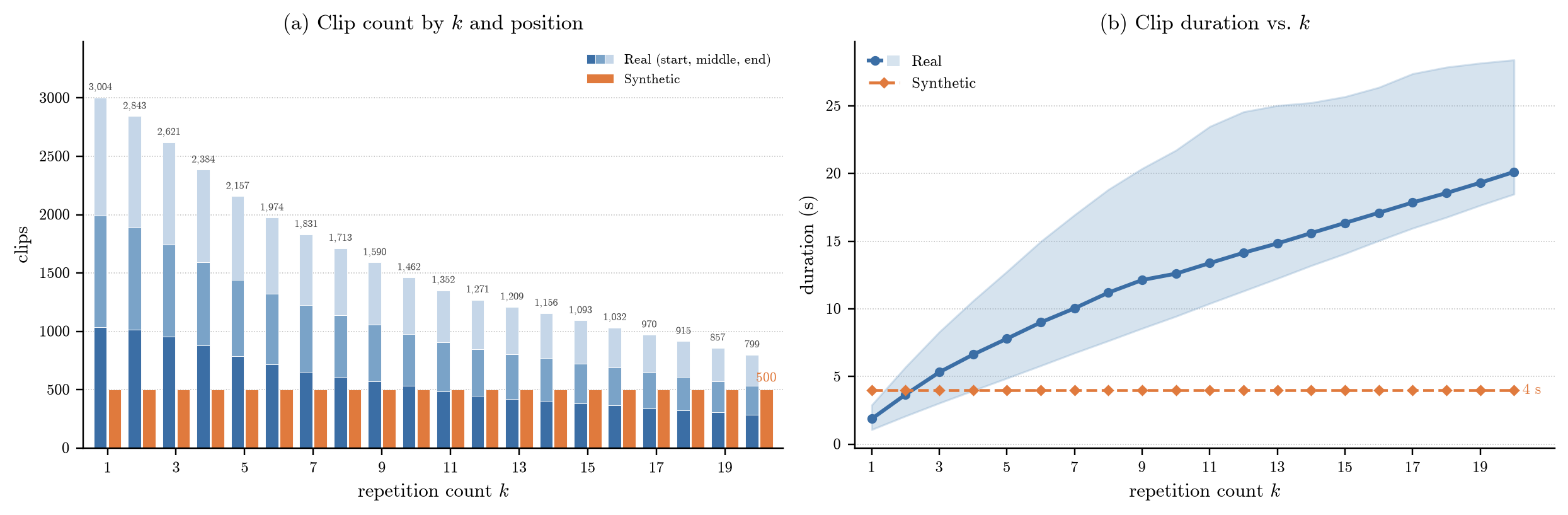
Clip counts by k and position, and clip duration versus k, for RepProbe-Real and a synthetic overlay.
RepProbe-Real: 32,233 clips from 1,038 sources, k = 1–20. Duration grows with k. The synthetic overlay holds length fixed at 4 s (500 clips per k).

Diagnosis

Representation vs. output: decodable but poorly reported

On a balanced evaluation set the same Cosmos-Reason2-8B model is queried twice: the integer generated from a count-only prompt, and a linear probe on the last prompt token at the final layer. The comparison localizes error to readout versus representation. Ground truth is the number of rest-pose intervals in the cut.

Generation

Model answer

The model answer.

Same model, same clip. The prompt asks for a count and nothing else.

READOUT 1 · GENERATION
Count the number of repetitions in this video. Return only an integer.
MAE  3.91

measures  conversion of a represented count into an emitted number.

Probe

Linear probe

Cosmos-Reason2-8B, layer 35.

A linear probe on the last prompt token at the final layer: the vector the language head reads before it writes a number.

READOUT 2 · LINEAR PROBE
Linear probe on L35, last token → k
MAE  2.49

measures  whether the model has formed the count. Decodability peaks at the last layer (sweep 2.91 → 2.51 → 2.49).

k is linearly decodable from the last-layer residual. It is not recovered at generation.

Main result

High-k collapse is a readout failure

Fine-tuning is not required to observe the split. On the same balanced clips, both readouts agree up to k ≈ 10. Past k ≈ 11, Cosmos-Reason2-8B’s generated error more than doubles while a linear probe on its last-layer residual stays approximately flat.

At k = 14–20, generation MAE is 6.34; the probe on the vector the language head reads is 2.75. Generation is biased low: 38.3% of its answers are 10 or less at k ≥ 14, against 10.6% for the probe. Both gaps hold under bootstrap confidence intervals.

6.342.75
0 8
MAE at k = 14–20, lower is better
Cosmos generated → L35 probe · −3.59

Evaluation

Zero-shot video-language models

Balanced 10,000-clip set, 500 clips per k. Models are prompted to return only an integer.

MAE mean |pred − k|. Exact pred = k. Off-by-1 |pred − k| ≤ 1. Few / mid / many MAE on k = 1–6, 7–13, and 14–20.

Model MAE ↓ Exact ↑ Off-by-1 ↑ Few 1–6 Mid 7–13 Many 14–20
Cosmos-Reason2-8B3.9113.0%37.8%1.913.206.34
Qwen3-VL-8B7.889.1%24.2%2.456.9713.43
InternVL3.5-8B8.976.4%17.2%6.417.2312.90
Video-R1-7B9.745.4%15.1%7.077.5214.23
VideoChat-R1.510.525.6%15.5%7.448.2715.41
LLaVA-OV-7B12.415.5%14.9%21.176.8610.47
LongVILA-R1-7B24.044.6%13.4%13.5124.1633.02

Best in each column in bold.

Cosmos generation versus linear probe

Same clips. The probe is a linear map on frozen last-layer activations of Cosmos-Reason2-8B, not a generative readout.

Readout MAE ↓ Exact ↑ Off-by-1 ↑ Few 1–6 Mid 7–13 Many 14–20
Cosmos-Reason2-8B3.9113.0%37.8%1.913.206.34
Cosmos L35 probe2.4925.0%50.3%1.622.992.75

The probe keeps a lower error at large k; generation MAE more than doubles for k = 14–20.

MAE versus ground-truth k for Cosmos generation and the Cosmos L35 probe.